History
Longmont history: a Chicago colony, a sugar town, its own power plant, a flood and a city of nearly 100,000
A stage stop called Burlington, a Chicago colony's square-mile town of 1871, a pea cannery and a sugar factory, a city that built its own power plant in 1912, a Klan council voted out, IBM, the 2013 flood, a fiber network and a city of 98,885. The short history of Longmont, Colorado, with sources.
· Checked October 5, 2026
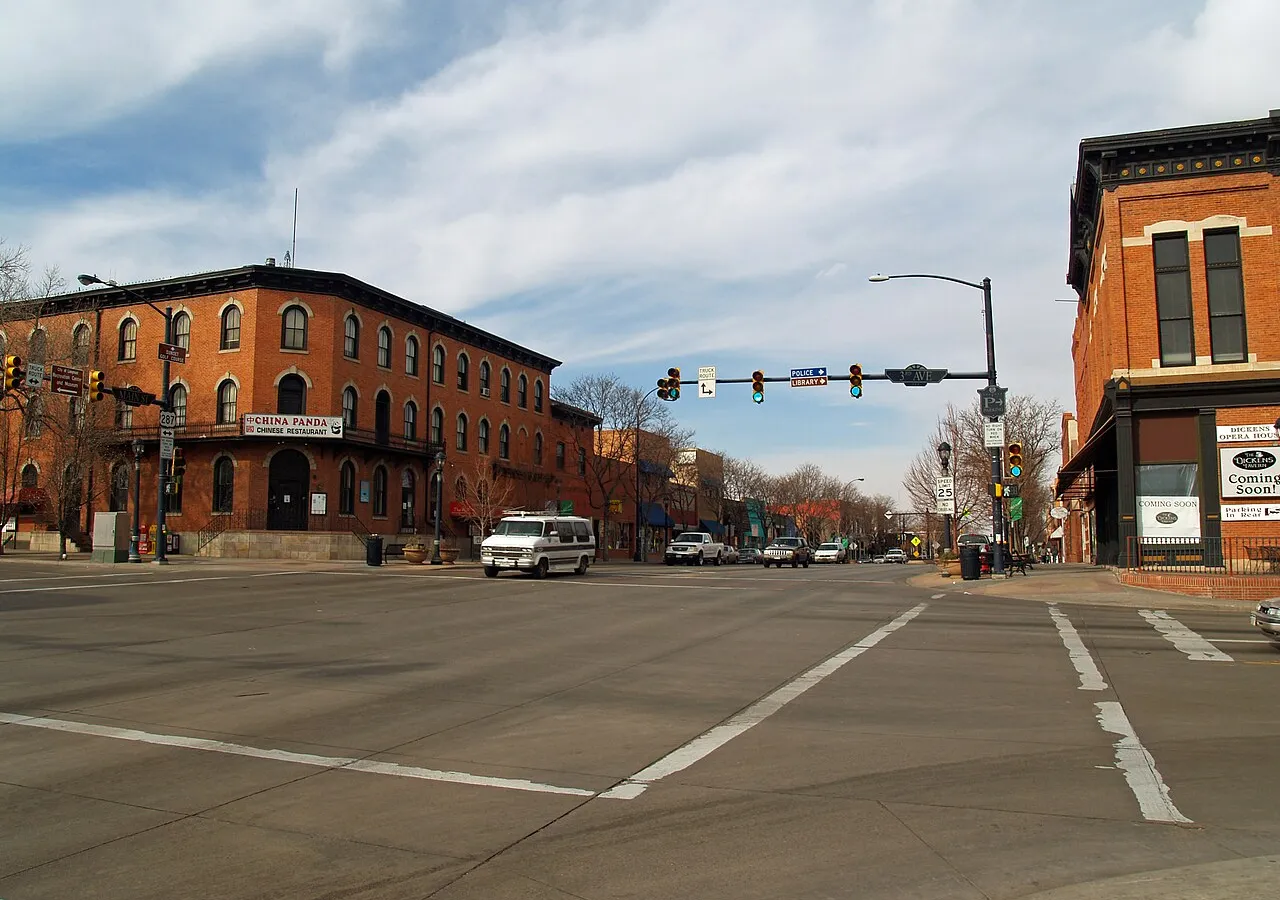
Longmont begins on land other people knew first. The City’s own history traces people here back at least 14,000 years; the Cheyenne, Arapaho and other Plains peoples followed the buffalo through Colorado, and the Arapaho often hunted and camped in the St. Vrain Valley from about 1800. Major Stephen H. Long reached the edge of the valley in 1820, and Longs Peak was named for him. The gold rush of 1858 brought miners who ignored the treaties the Cheyenne and Arapaho had signed, and the conflict that followed ended in 1868 with the military removal of both peoples to reservations in Wyoming and Oklahoma. By then a town called Burlington had grown up around the stage stop where the Overland Stage, on the line of today’s Main Street, crossed the St. Vrain.
The colony
The railroads reached Denver in 1870, and that year a group of prominent Chicago men began selling memberships in a new town, the Chicago-Colorado Colony, led by its president, Robert Collyer. The money bought thousands of acres for a town site and farms, and by the summer of 1871 the colonists had built a small town and named it Longmont for Longs Peak (mont is French for mountain). The plan was a square mile: stores along Main Street, a grid of homes around it and three parks, one of which is now Roosevelt Park. Burlington’s residents moved themselves and most of their buildings about a quarter mile north into the new town.
The Colorado Central Railroad, building north from Golden by way of Boulder, reached Longmont in 1873; the Panic of 1873 stalled it there, and the line north to Fort Collins and Wyoming was finished in November 1877. (Wikipedia gives 1877 for the arrival; the City and the Fort Collins history give 1873.) After an 1879 fire took the east side of the 300 block of Main Street, the downtown was rebuilt in brick. The Town of Longmont was incorporated on November 15, 1885, the date Wikipedia takes from the Colorado State Archives, though its own list of mayors begins in 1881. The census counted 773 people in 1880 and 1,543 in 1890.
Peas, beets and sugar
Irrigation canals made the dry, rich soil pay. Flour mills came in 1872, and in 1889 John H. Empson, a confectioner from Cincinnati, opened a cannery for peas and other vegetables. He patented pea-canning devices and bred a smaller, sweeter pea, and by 1903 the cannery, then the town’s largest employer, had 400 workers. Its brick warehouse at 15 3rd Avenue, listed on the National Register in 1984, served the Kuner-Empson Cannery until the end of 1970. A sugar factory went up on the east edge of town in 1903 and became part of the Great Western Sugar Company in 1905; by 1919 it could slice 2,350 tons of beets a day. The beet fields drew Swedes, Norwegians and Danes, Russian-Germans, Latinos from New Mexico, Texas and Mexico, and Japanese families; the high school’s football team was the Beetdiggers by 1908. By 1910, having doubled about every ten years, Longmont had 4,256 people.
The Dickens and the brick downtown
William Henry Dickens, a relative of the novelist, built the Dickens Opera House at Third Avenue and Main Street in 1881, with the Farmer’s National Bank downstairs and the auditorium above. It was expanded in 1905, the year the Masonic Temple next door burned and the opera house was saved; it stood empty from 1978 to 1986 and has been on the National Register since 1987. St. Stephen’s Episcopal Church of 1881, at 470 Main Street, is the city’s oldest standing church, saved from demolition by a community effort the St. Vrain Historical Society led. In 2017 the core of downtown, roughly Main, Coffman and Kimbark streets between 3rd and 5th avenues, was listed on the National Register as the Downtown Longmont Historic District: 83 buildings, 69 of them contributing, built between 1879 and 1967.
The Historical Society, incorporated in 1967, set up the landmark commission that became a city ordinance; the City’s preservation program formally began in 1971 and now counts more than 130 local landmarks, and Longmont was Colorado’s first Certified Local Government. The Society also keeps Old Mill Park on Pratt Street, on the site of a flour mill that burned in 1934, and the Hover Farmstead and Hoverhome, from a farm Charles Hover started in 1902.
City of Lights
Longmont had electric light from 1886, but by the end of the Northern Colorado Power Company’s 20-year franchise of 1892, residents could use their lights only from 6 to 8 pm and needed the council’s permission for an extra bulb. In April 1911 voters approved a city-owned utility by an overwhelming majority. When the company refused to sell, 63 residents pledged $1,000 each; when it won an injunction against the City’s bonds, many residents burned kerosene rather than buy its power. The hydroelectric plant west of Lyons, still in use, delivered its first power on January 5, 1912; on March 7 a final court ruling let the City serve customers, and about 125 connected by the next day. Longmont called itself the City of Lights, and the council gave every customer a free, unmetered porch light, a tradition that Longmont Power & Communications still keeps. In 1973 the City joined Fort Collins, Loveland and Estes Park in forming the Platte River Power Authority.
The Klan and the war
In the 1920s the Ku Klux Klan, then in power across much of Colorado, took control of the City Council, in 1923 by the City’s time line and 1925 by its narrative and by Wikipedia. The City’s history now acknowledges that community leaders of the period openly discriminated against and intimidated Catholics, Jews, Black residents, Latinos and immigrants. The council voted in 1926 to build Chimney Rock Dam on the North St. Vrain, and its estimated cost rose from $85,000 to $350,000; every Klan-aligned candidate lost in April 1927, work stopped, and the foundations are still visible in the river. More than 2,000 people from Longmont served in World War II; at home, Japanese Americans who had been imprisoned on the West Coast, and German and Italian prisoners of war, worked in the beet fields.
The square mile breaks open
Longmont had 8,099 people in 1950 and an economy built on farming. It adopted a home-rule charter in 1961, the Federal Aviation Administration opened an air traffic control center in the city in 1962, and in 1965 IBM announced a large plant between Longmont and Boulder. A town that had barely outgrown its square mile since 1871 went from 11,489 people in 1960 to 23,209 in 1970 and 42,942 in 1980, while the old industries closed: the Kuner-Empson cannery in 1970, the sugar factory in 1977. On August 14, 1980, a Longmont police officer shot and killed Juan Garcia and Jeff Cordova during an altercation after a traffic stop; he was acquitted of manslaughter, and the aftermath brought changes in police training and the founding of El Comite. Cutbacks at IBM and StorageTek slowed the 1980s; in the 1990s growth returned and Main Street, which Wikipedia calls nearly dead in the 1980s, revived. Seagate and Amgen came as farming waned, and the Butterball turkey plant, the last major agricultural industry in town, closed in 2011. The Longmont Museum, which opened its first exhibits in 1940 and has been a City department since 1970, reopens its galleries at 400 Quail Road on October 17, 2026, after a nearly $10 million expansion.
The flood
From September 11 to 15, 2013, Longmont had what the City calls the most devastating flash flood in its history, as the St. Vrain and Left Hand Creek overflowed into neighborhoods and business districts. The City’s ten-year report counts nearly 2,000 homes damaged or destroyed, about $150 million in damage to City infrastructure, four of the five water supplies destroyed, more than 400 rescues, and no lives lost in Longmont. More than 30 disaster-recovery grants, with $112 million in federal funding, paid for the recovery. The Resilient St. Vrain project has been widening the creek channel from the Left Hand confluence west to Hover Street; Sandstone Ranch was restored in 2018, and Dickens Farm Nature Area opened in 2020 as both a park and a basin for floodwater.
Fiber and the count
The fiber network grew out of the electric utility, which laid a 17-mile fiber loop with Platte River in 1997. A 2005 state law, Senate Bill 152, barred local governments from offering internet service without voter approval; Longmont voters gave that approval in 2011 with 60 percent of the vote. NextLight broke ground in 2014 and was built out by 2016, and in 2017 Longmont was declared Colorado’s first “Gig City,” with symmetrical gigabit speeds citywide.
The census counted 86,270 people in 2010 and 98,885 in 2020. The City’s history says Longmont passed 100,000 soon after; the Census Bureau’s 2024 estimate, as Wikipedia gives it, was 99,818. In 2021, its 150th year, Longmont signed a Sister City agreement with the Northern Arapaho, which the City calls the first such agreement between a city and a sovereign nation. Main Street still follows the Overland Stage road that Burlington grew up beside, Roosevelt Park still fills three blocks of the colony’s plan, and the free porch light the council promised every electric customer still shines, in many neighborhoods now as a pedestal or street light.
Sources
- History of Longmont, City of Longmont: the first peoples, Burlington, the colony, the 1873 railroad, the farm industries and their workers, the Klan, the war, the postwar industries and closings, the 1980 shooting, the flood, NextLight, the 2010 and 2020 censuses and the Northern Arapaho agreement.
- Longmont, Colorado on Wikipedia: Collyer, the name, the 1877 date, the 1885 incorporation and mayors list, Main Street, Seagate and Amgen, the earlier censuses and the 2024 estimate.
- Roosevelt Community Park, City of Longmont: the colony park.
- Railroads, Fort Collins History Connection: the Colorado Central in 1873 and 1877.
- Empson Cannery, Great Western Sugar Company, Dickens Opera House and Downtown Longmont Historic District on Wikipedia: the cannery, the sugar factory, the opera house and the 2017 district.
- Historic Preservation, City of Longmont: the 1971 program, the landmarks and the Certified Local Government.
- About Us and Our Properties, St. Vrain Historical Society: the Society, St. Stephen’s, Old Mill Park and the Hover properties.
- The History of Becoming a Public Power Utility, Longmont Power & Communications: the franchise, the 1911 vote, the 1912 plant, the porch lights and Platte River.
- About the Museum, Longmont Museum: its 1940 opening, 1970 City status and expansion.
- Ten Years After the Flood, City of Longmont, 2023: the damage, rescues, funding and Resilient St. Vrain work.
- About NextLight: the 1997 loop, Senate Bill 152, the 2011 vote, the 2014 groundbreaking and the 2017 “Gig City.”